Honey sold in the EU must meet the composition criteria of the Honey Directive 2001/110/EC: in blossom honey the sum of fructose and glucose must be at least 60 grams per 100 grams, moisture at most 20%, HMF at most 40 mg/kg and diastase at least 8. Since 14 June 2026, blended honey has had to show the share of each country of origin as a percentage on the label. In the European Commission's "From the Hives" action, published in 2023, 14 of 15 Turkish-origin samples were found suspicious; an EU buyer asking about syrup adulteration in Turkish honey has therefore become a routine step.
Which values does the EU Honey Directive require?
Annex II of the Directive lists the composition criteria honey must meet to be sold under the name "honey" on the EU market:
- Fructose and glucose combined: at least 60 grams per 100 grams in blossom honey, at least 45 grams in honeydew honey and its blends
- Sucrose: generally no more than 5 grams per 100 grams; 10 grams in false acacia, alfalfa and citrus honeys, 15 grams in lavender and borage honeys
- Moisture: generally no more than 20%; 23% in heather honey and baker's honey
- Water-insoluble content: no more than 0.1 grams per 100 grams (0.5 grams in pressed honey)
- Electrical conductivity: generally no more than 0.8 mS/cm; at least 0.8 mS/cm in honeydew and chestnut honey
- Free acid: no more than 50 milliequivalents per kilogram
- Diastase activity: at least 8 (at least 3 in honeys with low natural enzyme content where HMF does not exceed 15 mg/kg)
- HMF: no more than 40 mg/kg; 80 mg/kg in honeys of declared origin from tropical regions
The Turkish Food Codex Communiqué on Honey uses these core limits in largely the same way and adds δ13C, C4 sugar (no more than 7%), maltose and proline criteria. The differences are small but can change the outcome for an export batch. The Communiqué grants the 23% moisture exception to both heather and erica honeys; the Directive grants it only to heather (Calluna) honey and baker's honey. A company exporting erica honey therefore needs to check the batch against the Directive's own moisture limit.
What did the "From the Hives" action find?
In 2021 the European Commission launched a coordinated action to gauge the extent of sugar adulteration in honey imported into the EU. Between November 2021 and February 2022, 16 member states, Norway and Switzerland took 320 samples at border control posts. The results were published in March 2023:
- 147 of 320 samples (46%) were suspected of non-compliance with the Honey Directive.
- The highest absolute number of suspicious consignments came from China: 66 of 89 samples (74%).
- The highest relative share was for Türkiye: 14 of 15 samples (93%).
Two limits are worth keeping in mind when reading the findings. The Commission classified the results as "suspicious"; the analyses were qualitative and did not measure the proportion of syrup. The Commission also noted that the classic carbon isotope method was not effective at detecting the adulteration, which may be explained by maize and sugar cane syrups having been replaced by syrups from rice, wheat or sugar beet. EU buyers and authorities may therefore not be satisfied with an isotope report on its own.
How did labelling change after 14 June 2026?
Directive (EU) 2024/1438 changed the origin labelling rule in the Honey Directive. As set out by the Food Safety Authority of Ireland (FSAI), the new rules are:
- Where honey comes from more than one country, the countries of origin are shown in the principal field of vision, in descending order of their share by weight, each with its percentage.
- A tolerance of 5% is allowed for each share; it is calculated from the operator's traceability documentation.
- The rules apply from 14 June 2026; honey produced, labelled and placed on the market on or before that date may be sold until stocks run out.
- The European Commission has committed to publishing acts setting methods of analysis and the criteria for a traceability system by June 2029.
Because the tolerance is calculated from traceability documentation, the percentage printed on the label rests on the operator's records. An exporter selling bulk honey to an EU packer is expected to show, before filling, the origin and weight of every batch that makes up the blend. We covered how that record is matched with the analysis report when a query arrives in our post on export authenticity queries.
What has changed in Turkish regulation?
With the "decision criterion" added to the Communiqué on Honey in 2023, results of authenticity analyses are assessed against criteria built from studies representing authentic honeys produced in Türkiye and announced on the Ministry's website. An announced criterion starts to be applied in official controls three months after publication. We explain what this change means for laboratory methods in our post on fake honey. Which analyses the export report will include should be agreed with the buyer at the contract stage.
Where does Beevex sit in this chain?
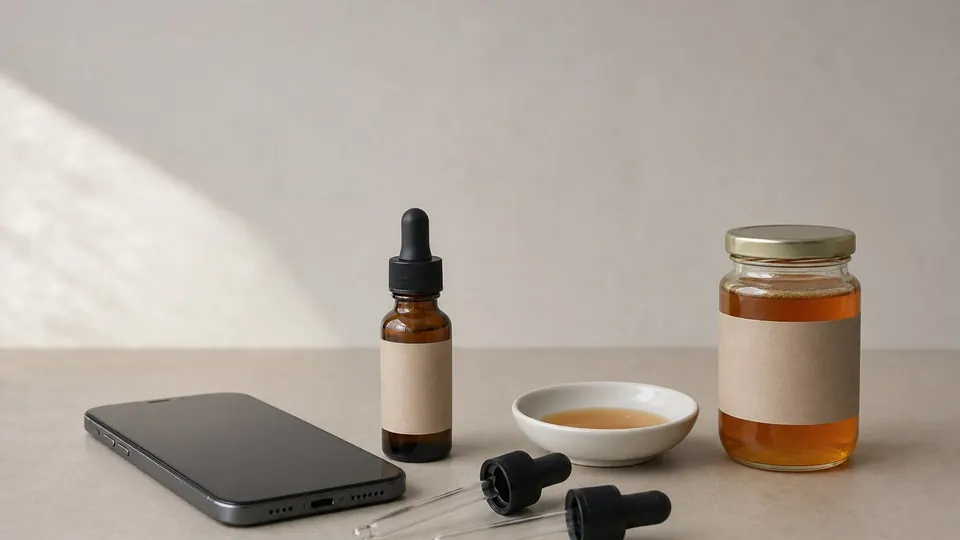
Beevex is used at the intake step at the start of the export chain. Five drops taken from a producer's batch are transferred to the kit's test dish, the mobile app returns the result as genuine, questionable or syrup added, and the result is recorded with the batch information. In the export file, that record shows how the batch was assessed at intake; a questionable batch is set aside before it enters the blend.
Beevex does not measure floral source and does not replace the accredited laboratory analysis required for export. You can find how exporters apply it on our sector page.
Sources
- Council Directive 2001/110/EC relating to honey, Annex II (composition criteria)
- Council Directive 2001/110/EC, EUR-Lex
- Directive (EU) 2024/1438, EUR-Lex
- Food Safety Authority of Ireland, Honey: origin labelling rules from 14 June 2026
- European Commission, EU coordinated action "From the Hives" (Honey 2021-2022)
- Turkish Food Codex Communiqué on Honey (No. 2020/7) and Annex 1
- Communiqué amending the Communiqué on Honey (No. 2023/37), Official Gazette, 24 November 2023
- Ministry of Agriculture and Forestry, amendment to the Turkish Food Codex Communiqué on Honey