Fake honey, or honey with added sugar syrup, cannot be reliably detected by home tests such as water, a match, pouring from a spoon or crystallisation. The outcome of those tests depends on the honey's moisture, floral source and the room temperature. Added syrup is confirmed in a laboratory, by carbon isotope ratio (C4 sugars), sugar profile and methods such as mass spectrometry or NMR. For a business that collects or packs honey, the workable route is to screen at the point of intake and send only the suspect batches to the laboratory.
What does fake honey mean?
The Turkish Food Codex Communiqué on Honey does not allow any food ingredient, food additive or other substance to be added to honey, including anything added for flavour. In the market, "fake honey" usually means one of three things:
- Glucose, fructose or invert sugar syrup blended into honey
- A product made entirely from syrup sold under the name honey
- A cheap honey labelled as a more valuable floral or regional honey
The first two are adulteration. The third is a question of botanical source or origin; it is investigated with other methods, such as pollen analysis, and is not the subject of this post.
What do home tests actually show?
Each one looks at a physical property of honey. That property varies widely among natural honeys too, so the outcome says nothing about added syrup.
Dropping into water. How quickly honey disperses in water depends largely on its moisture. The Communiqué allows up to 20% moisture in blossom honey and up to 23% in heather and erica honeys. Natural honey with higher moisture also disperses easily.
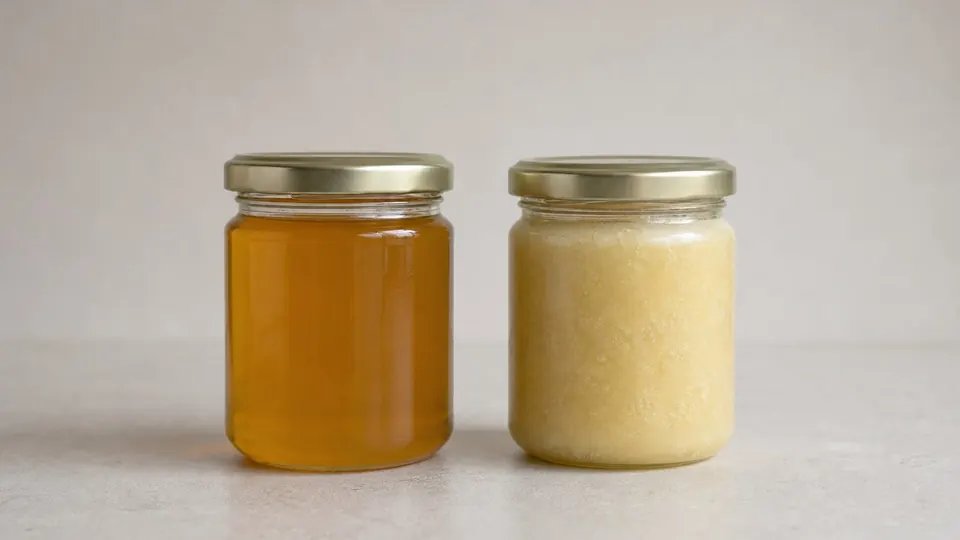
Crystallisation. The Communiqué explicitly accepts that honey may be fluid, viscous, or partly or fully crystallised. How fast it crystallises depends on the balance between glucose and fructose and on temperature. A jar that sets is not proven genuine, and a jar that stays runny is not proven fake.
Pouring from a spoon. Viscosity changes with temperature and moisture. Honey that stands on a spoon in winter can run in summer.
The match test. The claims made about it contradict each other; its outcome cannot support a decision.
How does a laboratory find syrup?
Annex 1 of the Communiqué on Honey contains criteria aimed at added syrup. The best known is carbon isotope analysis. Maize and sugar cane are C4 plants; syrup made from them carries a different carbon isotope ratio from the C3 plants that provide most of the nectar bees collect. The Communiqué sets three limits:
- The honey's δ13C value: -23 or more negative (-22.5 for pine honey)
- The difference between the δ13C values of the honey's protein and the honey: -1.0 or more positive
- The C4 sugar share calculated from these values: no more than 7%
The sugar profile is a second line of evidence. In blossom honey the sum of fructose and glucose must be at least 60 grams per 100 grams; sucrose generally must not exceed 5 grams per 100 grams and maltose must not exceed 4%. A marked deviation from this balance raises the suspicion of syrup.
Why is isotope analysis no longer enough?
Syrups made from rice, wheat or sugar beet are C3-based and resemble honey in their isotope ratio. When it published the results of its "From the Hives" action, the European Commission noted that the classic isotope method was not effective at detecting adulteration, and that maize and sugar cane syrups may have been replaced by these syrups. We cover the action's findings and what they mean for exporters in our post on exporting honey to the EU.
Turkish regulation has changed accordingly. In 2023 the concept of a "decision criterion" was added to the Communiqué on Honey: results of authenticity analyses are assessed against criteria built from studies representing authentic honeys produced in Türkiye and announced on the Ministry's website. The Ministry of Agriculture and Forestry announced that advanced methods such as mass spectrometry and NMR will be used in official controls to detect substances added from outside.
What should you check on the label?
A label does not reveal adulteration, but it rules some products out. A product listing glucose syrup, fructose syrup or sugar among its ingredients is not honey. Under the Communiqué, baker's honey is sold with the statement "for cooking purposes only". Where a label is complete, the label alone still proves nothing about the contents.
For consumers, the firmest route is to buy from a producer whose source they know, or from a brand that can share its analysis documents.
What does Beevex do at the point of intake?
A business that collects, packs or exports honey cannot send every batch to the laboratory; the intake decision is often made while the vehicle waits on the weighbridge. Beevex is a screening step used at that point. Five drops taken from the jar are transferred to the kit's test dish, the mobile app assesses two images and the result comes back as genuine, questionable or syrup added. The result is recorded with the batch information.
Beevex does not measure floral source and does not replace laboratory analysis. You can find the application steps in how we work and the method on the technology page.
Sources
- Turkish Food Codex Communiqué on Honey (No. 2020/7), Official Gazette, 22 April 2020
- Communiqué on Honey, Annex 1: other characteristics of honey (moisture, sugars, δ13C, C4 sugars)
- Communiqué amending the Communiqué on Honey (No. 2023/37), Official Gazette, 24 November 2023
- Ministry of Agriculture and Forestry, amendment to the Turkish Food Codex Communiqué on Honey
- European Commission, EU coordinated action "From the Hives" (Honey 2021-2022)