Under the Turkish Food Codex Communiqué on Honey, pine honey is defined as a honeydew honey and assessed against the honeydew column of Annex 1. In that column, fructose plus glucose must be at least 45 g per 100 g and electrical conductivity at least 0.8 mS/cm; for blossom honey the limits are 60 g and at most 0.8 mS/cm. Isotope analysis differs too: in pine honey the honey δ13C value must be -22.5 or more negative, while the C4 sugar share and the δ13C difference between protein and honey are not required. An assessment that reads pine honey against blossom honey criteria can make a genuine batch look non-compliant.
How is pine honey defined in Turkish legislation?
The Communiqué on Honey (No. 2020/7) divides honey by source into blossom honey and honeydew honey. Honeydew honey comes from secretions of living parts of plants, or from excretions of plant-sucking insects living on plants. Pine honey is a sub-type: honeydew honey produced when bees collect and transform the honeydew that Marchalina hellenica (a scale insect) forms from the sap of pine trees such as Pinus brutia, P. nigra and P. pinea.
Two practical consequences follow from the definition:
- Colour: The Communiqué requires honeydew honey to be at least 60 on the Pfund scale.
- Label: Honeydew honey from pine is sold as "çam balı" (pine honey); the term "salgı balı" (honeydew honey) may also be used alongside it.
What does the honeydew column of Annex 1 require differently?
Annex 1 has four columns: blossom honey, honeydew honey, blend of blossom and honeydew honey, and baker's honey. The right column for pine honey is honeydew honey. The rows where it differs from blossom honey:
| Criterion | Blossom honey | Honeydew honey (including pine honey) |
|---|---|---|
| Fructose + glucose (minimum) | 60 g/100 g | 45 g/100 g |
| Fructose/glucose ratio | 0.9-1.4 (different ranges for chestnut, acacia and thyme honeys) | 1.0-1.4 |
| Electrical conductivity | At most 0.8 mS/cm (at least 0.8 for chestnut honey; certain types excluded) | At least 0.8 mS/cm |
| Honey δ13C value | -23 or more negative | -23 or more negative; -22.5 or more negative for pine honey |
| Difference between protein and honey δ13C | -1.0 or more positive | -1.0 or more positive; not required for pine honey |
| C4 sugar share (maximum) | 7% | 7%; not required for pine honey |
The general values apply to honeydew honey on the rows for moisture (20%), sucrose (5 g/100 g), maltose (4%), water-insoluble matter (0.1 g/100 g), free acidity (50 meq/kg), diastase number (at least 8), HMF (at most 40 mg/kg) and proline (at least 300 mg/kg). The botanical exceptions in the blossom column (for example, at least 500 mg/kg proline in chestnut honey) do not appear in the honeydew column.
The minimum pollen shares in Annex 2 are given only for blossom honeys with a declared botanical source; pine honey is not on the list. Pine honey's identity is assessed through honeydew characteristics, not pollen share.
Why is the C4 test not required for pine honey?
The Communiqué does not state its reasons for the exception. Published research, however, shows that the standard method does not give reliable results on pine honey.
The C4 test (AOAC 998.12) uses the protein extracted from the honey as an internal standard; we explain the logic in our post on the C4 sugar test. A study published in the Journal of Food Composition and Analysis in 2022 reported that most genuine pine honey samples failed AOAC 998.12. According to the authors, small insoluble honeydew particles in pine honey precipitate with the protein during flocculation and shift the protein δ13C value. When the protein was isolated and cleaned up by ultrafiltration, most samples that had looked adulterated in the earlier test were classified as authentic.
A study published in European Food Research and Technology in 2023, covering 373 Turkish pine honey samples collected from 47 regions between 2015 and 2017, points the same way: all samples showed honeydew characteristics and the physicochemical parameters met the honeydew criteria, but the C4 sugar share and the protein-honey δ13C difference did not meet the regulatory criteria and showed a wide spread.
The exception has a consequence: in pine honey, the only isotope criterion is the honey δ13C value. That value may catch some C4-derived sugar, but it cannot see C3-derived syrups such as rice, wheat or beet. If syrup is suspected in pine honey, the sugar profile and other methods need to be examined separately.
What happens when pine honey is read against blossom honey criteria?
If the honey type is not written on the sample request, or the wrong column is chosen in the report, a genuine pine honey can look non-compliant on several rows at once:
- If fructose plus glucose is between 45 and 60 g, a value that is fine for honeydew honey falls below the blossom honey limit.
- If conductivity is above 0.8 mS/cm, the value expected of honeydew honey exceeds the blossom honey limit.
- If the C4 share and protein difference are calculated and compared with blossom honey thresholds, the false positive tendency reported in the literature turns directly into a decision.
The reverse matters as well. If blossom honey is declared as pine honey, the looser isotope criterion is applied. A declaration rests on the honeydew characteristics the Communiqué defines appearing together: a colour of at least 60 on the Pfund scale, conductivity of at least 0.8 mS/cm and sugar values within the honeydew column.
Which column applies to a blend of blossom and honeydew honey?
Annex 1 has a separate column for blends. In it, fructose plus glucose must be at least 45 g/100 g and the ratio 1.0-1.4. Electrical conductivity is generally at most 0.8 mS/cm; for blends of chestnut honey and of honeydew honey it is given as at least 0.8 mS/cm.
On the isotope rows, the blend column does not carry the pine honey exception: honey δ13C -23 or more negative, protein difference -1.0 or more positive, C4 sugar share at most 7%. So when pine honey is blended with another honey, the blend does not benefit from the isotope exception granted to pine honey. These rows should be checked separately when a blend recipe is set up.
What should exporters watch for with pine honey?
The EU Honey Directive (2001/110/EC) also sets fructose plus glucose at a minimum of 45 g/100 g and electrical conductivity at a minimum of 0.8 mS/cm for honeydew honey and its blends. Annex II of the Directive contains no δ13C or C4 criterion. If a buyer asks for a C4 test, the method to be used and its known limits on pine honey should be discussed at contract stage. We cover the general EU rules in our post on exporting honey to the EU.
How is Beevex used with pine honey?
Beevex does not measure honey type, or floral or honeydew source; that information is recorded as a declaration. The question it looks at is added syrup. At intake, five drops taken from the jar go into the kit's test dish, the mobile app gives the result as genuine, questionable or syrup added, and the result is recorded with the batch details. A questionable batch is set aside for the laboratory, and the column the laboratory should assess against is stated with the sample. Beevex does not replace laboratory analysis. You can see how it is used at collection centres on the sector page.
Frequently asked questions
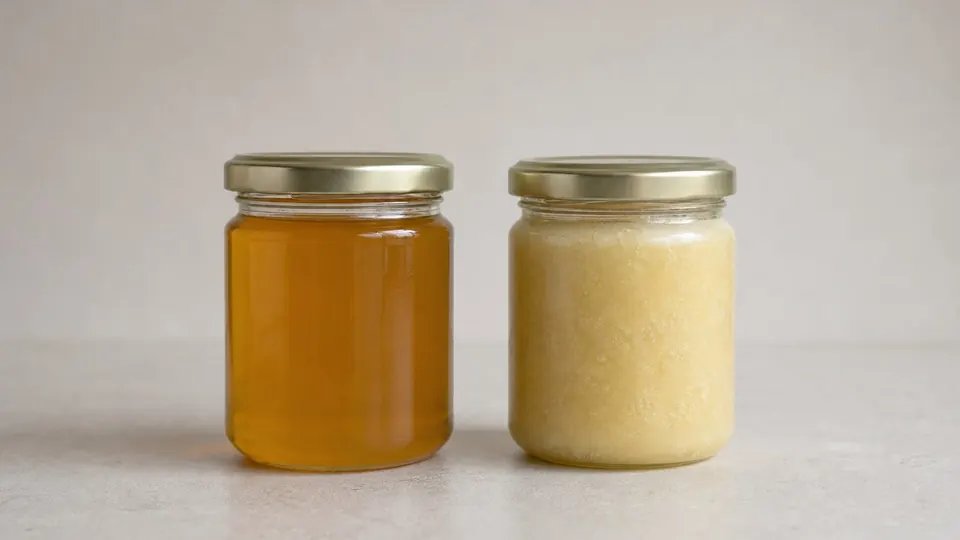
Does pine honey crystallise? The Communiqué accepts that honey may be fluid, viscous, or partly or fully crystallised. Crystallising or not crystallising is not on its own a sign of fakery.
Is there any point in a C4 test on pine honey? The Communiqué does not require the C4 share or the protein difference for pine honey. If a buyer asks for the test, the method should be agreed in advance, because the literature reports a false positive tendency in pine honey.
What should electrical conductivity be in pine honey? The Communiqué defines conductivity for honeydew honey as a lower limit: at least 0.8 mS/cm. For blossom honey the same value is, apart from chestnut and certain types, an upper limit. This row is one of the criteria that separate pine honey from blossom honey.
Can a blend of pine and blossom honey be sold as "pine honey"? The Communiqué defines a separate column for blends and gives the name "çam balı" to honeydew honey whose source is pine. For a labelling decision, the current text of the Communiqué and the Regulation on Food Labelling and Consumer Information apply; this post is not legal advice.
Does pine honey need pollen analysis? The minimum pollen shares in Annex 2 are given for blossom honeys and do not cover pine honey. Pine honey's identity is assessed against the honeydew criteria.
Sources
- Turkish Food Codex Communiqué on Honey (No. 2020/7), Official Gazette, 22 April 2020
- Communiqué on Honey, Annexes 1 and 2: other characteristics of honey and minimum pollen content
- Communiqué amending the Communiqué on Honey (No. 2023/37), Official Gazette, 24 November 2023
- Council Directive 2001/110/EC relating to honey, Annex II
- Akyıldız et al., false positive tendency of the AOAC 998.12 C4 test for pine honey, Journal of Food Composition and Analysis, 2022
- Uçurum et al., characterisation of Turkish pine honey by geographical origin, European Food Research and Technology, 2023